Ancient City of Polonnaruwa
Best Time to Visit
The dry months from May to September are the most comfortable for exploring the open ruins. The early morning and late afternoon hours offer the best light for photography and cooler temperatures.
Overview
Polonnaruwa succeeded Anuradhapura as the island’s capital in the 11th century and flourished as a centre of political power, Buddhist scholarship, and architectural innovation until the 13th century. Unlike the more sprawling ruins of Anuradhapura, Polonnaruwa’s archaeological zone is relatively compact, making it easier to explore in a single day while offering an even richer concentration of sculptural and architectural masterpieces.
The city reached its zenith under King Parakramabahu I (1153-1186 CE), a visionary ruler who transformed Polonnaruwa into a thriving metropolis. He constructed the massive Parakrama Samudra reservoir, expanded the Royal Palace, and commissioned many of the religious monuments that still stand today. His famous declaration, “not even a little water that comes from the rain must flow into the ocean without being made useful to man,” speaks to the advanced irrigation engineering that defined the era.
What to See
Royal Palace of Parakramabahu
The ruins of the Royal Palace hint at its former grandeur. Historical records suggest the original structure stood seven storeys tall and contained over 1,000 rooms. Today, the thick brick walls rise three storeys, with holes that once held massive timber beams still visible. The Audience Hall nearby features a stunning series of stone elephant carvings along its base, each one unique in its pose and expression.
Gal Vihara
The undisputed highlight of Polonnaruwa, Gal Vihara consists of four magnificent Buddha statues carved from a single massive granite outcrop in the 12th century. The group includes a seated Buddha in deep meditation, a smaller seated figure within a decorated chamber, a majestic 7-metre standing figure with arms crossed in an unusual pose, and a serene 14-metre reclining Buddha entering Parinirvana. The craftsmanship and emotional expression of these sculptures are considered among the finest examples of Sinhalese rock carving ever produced.
Vatadage (Circular Relic House)
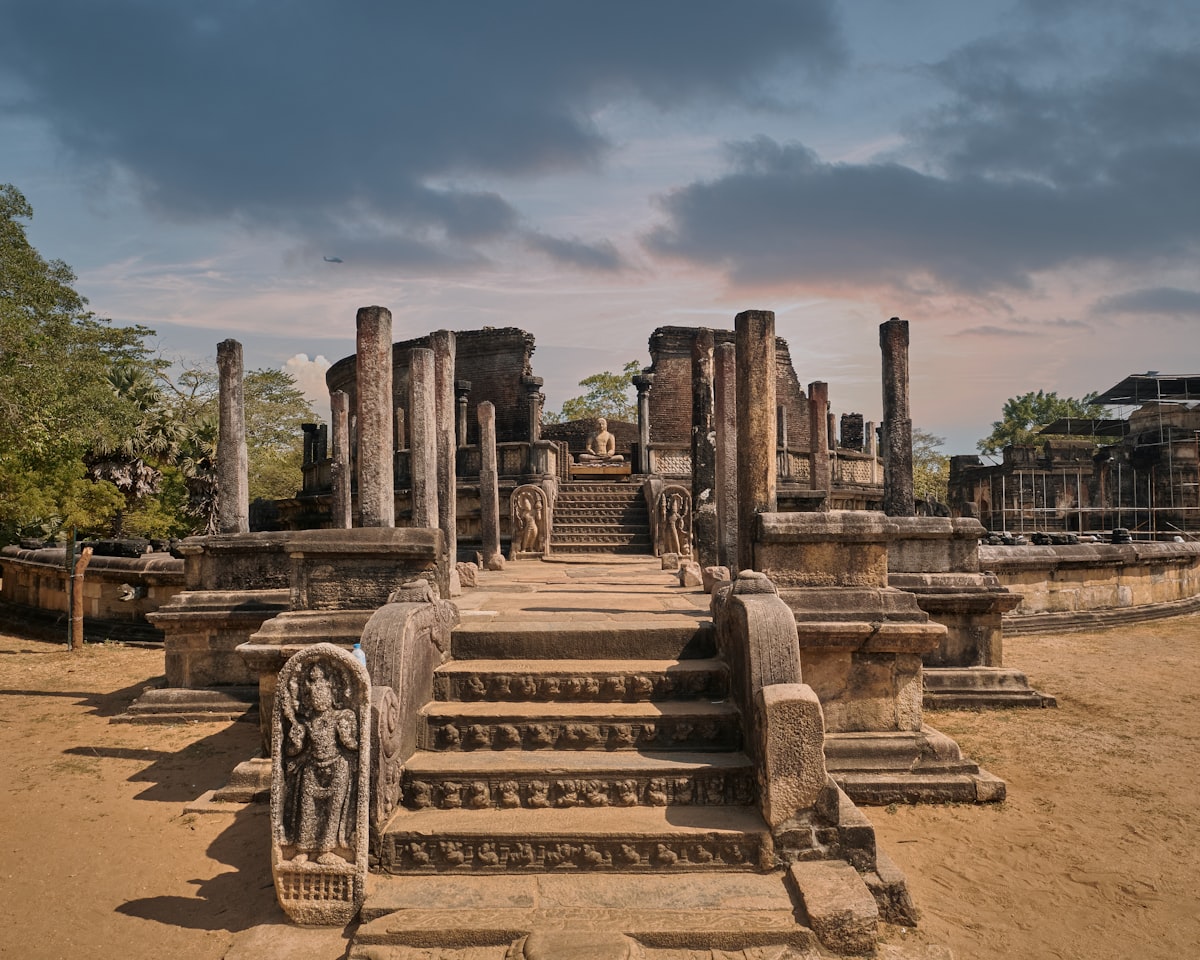
Perhaps the most architecturally refined structure in Polonnaruwa, the Vatadage is a circular relic house built to protect a small stupa. It features concentric rows of stone columns, four entrances guarded by elaborately carved guard stones, and some of the most beautiful moonstones in Sri Lanka. The geometric precision and decorative artistry of this building are extraordinary.
Lankathilaka
This towering image house still rises to an impressive height, its massive brick walls framing a standing Buddha statue at the far end of a narrow corridor. The sheer scale of the building, with its soaring walls open to the sky, creates a dramatic and contemplative atmosphere.
Parakrama Samudra
This enormous medieval reservoir, stretching over 2,500 hectares, was engineered by King Parakramabahu I by connecting three existing tanks. Remarkably, it remains in active use today, irrigating the surrounding rice paddies. A walk or cycle along its bund at sunset is a peaceful way to end a day of exploration.
Polonnaruwa Museum
Located near the main entrance to the archaeological zone, the museum provides excellent context for the ruins with scale models, artefacts, and informative displays. Visiting the museum first significantly enhances the experience of touring the sites.
Tips for Visitors
- Rent a bicycle: Like Anuradhapura, cycling is the ideal way to navigate the archaeological zone. Bicycles are available for hire near the museum and along the main road for around LKR 500-800 per day.
- Start at the museum: Purchasing your ticket and viewing the exhibits first gives you a much richer understanding of what you will see at each site.
- Dress modestly: Shoulders and knees should be covered at Buddhist sites. Remove shoes and hats before stepping onto raised platforms at religious monuments.
- Combine with Sigiriya: Polonnaruwa is easily paired with Sigiriya and Dambulla as part of a Cultural Triangle itinerary spanning two to three days.
- Watch for monkeys: Toque macaques and grey langurs are plentiful throughout the site. Keep food secured and maintain a respectful distance.
- Afternoon light at Gal Vihara: The late afternoon sun illuminates the rock-carved Buddhas beautifully, making it the best time for photography.
Photo Gallery
How to Get There
By Bus
LKR 500 - LKR 1,200Buses via Dambulla are more frequent; change at Dambulla or Habarana if no direct service available
By Train
LKR 300 - LKR 1,600The train station is at Kaduruwela, about 4km from the Old Town archaeological zone; a tuk-tuk to the ruins costs around LKR 500
Private Vehicle
LKR 16,000 - LKR 24,000Easily combined with Sigiriya and Dambulla in a Cultural Triangle tour
Entrance Fees
| Visitor Type | Adult | Child |
|---|---|---|
| Sri Lankan Visitors | LKR 50 | LKR 25 |
| Foreign Visitors | $25 | $13 |