Ritigala Ancient Monastery
Best Time to Visit
The dry seasons from January to March and June to September are best, as the forest trails can become slippery and leech-infested during the monsoon months. Early morning visits offer the most atmospheric conditions with mist clinging to the ruins.
Overview
Rising abruptly from the flat scrubland of the North Central dry zone, Ritigala is a mysterious mountain draped in dense tropical forest and shrouded in legend. At 766 metres, it is the highest point in the northern plains, and its upper slopes generate their own microclimate — perpetual mist, cooler temperatures, and a lush canopy that supports plants found nowhere else in the lowlands. Hidden within this forest are the atmospheric ruins of an ancient Buddhist monastery that dates back to at least the 1st century BCE.
Unlike the grand stupas and restored monuments of Anuradhapura or Polonnaruwa, Ritigala’s ruins remain largely unrestored, consumed by the jungle and all the more evocative for it. The site is believed to have been a pamsukulika (ascetic) monastery, home to monks who embraced the strictest rules of monastic life, meditating in the forest far from civilisation. According to the Ramayana, Ritigala is also said to be a fragment of the Himalayas dropped by Hanuman while carrying medicinal herbs — a legend reflected in the extraordinary variety of medicinal plants found on the mountain.
What to See
The Monastic Complex
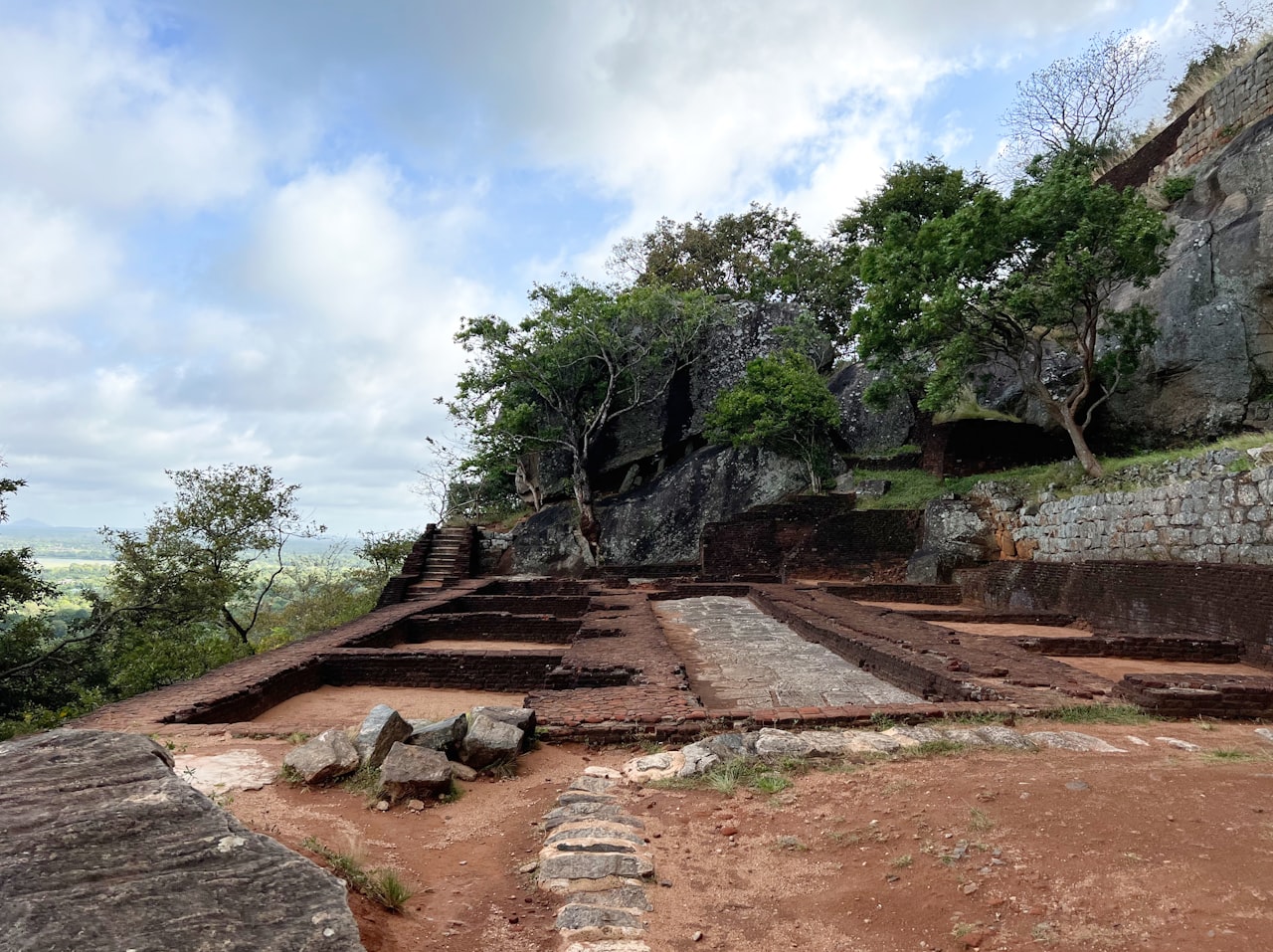
The main archaeological area follows a stone-paved pathway that winds uphill through the forest, connecting a series of raised stone platforms, meditation terraces, and ruined buildings. The craftsmanship of the stonework — precisely cut and fitted without mortar — is remarkable. Double-platform structures (known as padhanaghara) are unique to Ritigala and a handful of other forest monasteries.
The Stone Bridge and Moat
The monastery entrance is marked by an ancient stone bridge spanning a dry moat. Beyond it, a long causeway lined with stone slabs leads deeper into the forest. The bridge and surrounding walls are beautifully preserved and give a sense of the scale and planning of the original complex.
The Hospital Ruins
A ruined building near the entrance is believed to have been an ayurvedic hospital. A large stone medicinal trough (beheth oruwa) — similar to those found at Mihintale — was discovered here, suggesting that the monks practised traditional medicine using the mountain’s abundant medicinal flora.
The Forest Trail
The walking trail through the ruins stretches approximately 2 kilometres into the forest. The canopy overhead is dense, with towering trees, creeping lianas, and a carpet of leaf litter. The atmosphere is profoundly quiet, punctuated only by birdsong and the occasional rustle of a monitor lizard or grey langur.
Ritigala Strict Nature Reserve
The mountain and its surroundings are protected as a strict nature reserve. The forest harbours an unusually rich array of plant species — including rare orchids, ferns, and medicinal herbs — along with wildlife such as leopards, sloth bears, sambur deer, and a remarkable variety of birds and butterflies.
Tips for Visitors
- Wear proper footwear: The forest trails can be uneven, rocky, and slippery after rain. Sturdy walking shoes or boots are essential.
- Bring insect repellent: Leeches are common during and after wet weather, particularly from October to January. Tuck trousers into socks and apply repellent.
- Carry water: There are no shops or facilities at the site. Bring sufficient water and snacks.
- Allow 2-3 hours: The walking trail is not long, but the atmosphere invites slow exploration and photography.
- Hire a guide: A local guide can point out features easily missed and share the legends associated with the site. Guides are sometimes available at the entrance.
- Combine with Cultural Triangle: Ritigala is best visited as a side trip from Habarana, Sigiriya, or Dambulla, all of which have good accommodation options.
- Respect the site: Ritigala is both an archaeological site and a nature reserve. Stay on the marked paths and do not remove any stones, plants, or artefacts.
Photo Gallery
How to Get There
By Bus
LKR 400 - LKR 1,000No direct bus to Ritigala. Take a Habarana-bound bus, alight at Ganewalpola junction, then a tuk-tuk (3 km) to the site entrance.
Private Vehicle
LKR 14,000 - LKR 20,000A private vehicle is strongly recommended as public transport is very limited. The last 3 km is a narrow road through the forest. Combine with Sigiriya or Anuradhapura.
By Tuk-tuk
LKR 3,000 - LKR 5,000Arrange a return tuk-tuk as there is no transport at the site. Drivers usually wait while you explore.
Entrance Fees
| Visitor Type | Adult | Child |
|---|---|---|
| Sri Lankan Visitors | LKR 0 | LKR 0 |
| Foreign Visitors | $10 | $5 |